Wednesday, 5 October 2011

Zucca

In reality, the British ‘love affair’ with Italian food has more to do with convenience and a lack of adventure than a particular affinity for the produce, flavours or cooking of Italy.

Pasta is filling and quick to make, with students and ‘busy young professionals’ buying tons of rubbery shop-bought tortellini that comes with that bizarre, tasteless paste in the middle. ‘Spag bol’ is an ever-present dish in the repertoires of mums across the country but, judging by supermarket shelves, their versions must often taste of sweet tomato sauce. The distinction between American pizza and Italian pizza is worth pointing out too, as there isn’t anything particularly Italian about a deep pan pizza with a cheese and pepperoni stuffed crust, or one with pineapple on it.

Things don’t get much better when you go out to the average Italian restaurant either. It seems that normal expectations of the food in an Italian restaurant are so low that the chef can serve anything he likes, provided it comes on a doughy base or is mixed up with pasta, usually overcooked. People make excuses about it tasting 'homemade' when actually it's just crap. The other week I had the misfortune to eat in Buona Sera, an unfathomably busy Italian restaurant at Clapham Junction, which serves a pizza covered in nothing but melted hard mozzarella cheese, tomato sauce and three strips of parma ham rendered tasteless by a bake in the oven. The red served in that place would make anyone with a remote interest in decent wine cry.

Yet Italian restaurants like Buona Sera seem to do well, perhaps because people think of Italian as cheap and cheerful slap-up food; after all, how far wrong can you go with pizza, lasagne or penne? Well, quite wrong given the evidence.

Maybe people just don’t care about the food and want something hot over which to chat. I assume restaurants like Buona Sera, of which there are many, must rely on these punters, as well as the ones who remove basil leaves from their food as if they were inedible decoration. The food in these places is certainly bland enough to allow the unadventurous to feel exotic for eating out without causing them to worry about an encounter with any challenging or unfamiliar flavours, or flavour at all for that matter.

The trouble with all of this, with the jars of Dolmio, the squash-ball mozzarella, the parmesan smelling of feet, the overcooked pasta, the deep-pan pizza, the Tesco tortellini, the boring lasagne and the uninspired Italian restaurant menus, is that they give Italian food a bad image. Enter Zucca.

When we sat down for this meal, I didn’t really know what to expect. Zucca is an Italian restaurant in Bermondsey that has received positive reviews and won awards (it was voted in the top three Italian restaurants in Europe by 'The World's 50 Best' judging panel) but then so has Bocca Di Lupo in Soho and I consider it one of the most overrated restaurants on the planet having eaten there. I've had so many below par Italian meals that it's hard to have high expectations for the next. Poor me.

The design and style of Zucca is ultra-modern but, remarkably for a new restaurant, there are tablecloths, which soften the edges and prevent the interior from feeling too stark. The dining room is beautifully lit inside and tables are well-spaced. I’ve realised recently just how much this impacts on the feel of a restaurant, and when we were shown to our seats we could see diners taking advantage of the room to lean back in their seats and laze around in post-meal leisure. They looked encouragingly content. For a fully booked Saturday night there was a remarkably calm, relaxed atmosphere in the dining room and none of the frantic bustle you feel in some busy restaurants.

Picking up the menu, the first things to notice are that it’s small and features only two pasta dishes. There’s no pizza. Good. The prices are also staggeringly cheap for a wildly hip restaurant such as this – antipasti dishes are £4-£6 and mains are between £10 and £15.

Amongst the antipasti is the carpaccio of sea bass, a dish that has recieved such lashings of praise in reviews that I began to wonder whether, in some bizarre anthropomorphic twist, a sea bass carpaccio had taken over the planet and was holding the children of food critics hostage. Reasonably unlikely, but either way we ordered the dish along with smoked eel bruschetta.

Not being a recognised food critic or having any children to kidnap, I can report under no duress that the thin fillets of sea bass had a beautiful texture, both meaty and soft, and a delicate fishy flavour. The chilli and olive oil dressing was unusual but it worked. Customers can buy bottles of the olive oil used by the kitchen from the restaurant and they probably should.

The bruschetta was on another level entirely. I’ve had smoked eel before and loved it but not like this. This was proper chunks of eel steak, rather than the shredded stuff I had in the past, and my slippery dead chum had been imbued with an incredibly complex, strong smoky flavour. It came with big, salty capers and fennel, all of which was sat atop toasted homemade bread. The whole dish was a pleasure to eat, for the contrasting textures as well as the flavours.

If you’re in the business of condoning the slaughter of animals for human consumption, why not eat all of them, provided they have been treated decently (the murder bit aside)? This was roughly my thinking when ordering veal chop and spinach for my main course, that and ‘I bloody love veal and want to order it’. And worry not little cow who art in little cow heaven; the chef at Zucca made sure that you will live on for eternity in my memory.

For this chop was one of the most mind-blowingly tasty hunks of flesh I have ever eaten. It was so good that I couldn’t help smiling with joy between mouthfuls; I almost laughed out loud at one point.

It arrived looking like a slightly small, slightly pale T-bone steak, with big, thick black lines seared on it from the grill. Cooked the medium side of medium-rare, it was pink and juicy and more tender than beef. I love the taste of charcoal, salt and meat together and this was all three in perfect harmony.

It was a large piece of veal but every mouthful was as good as the first and when it was all gone I had that feeling the little boy has in The Snowman when he runs outside to find his mate has melted. I have been fortunate enough to eat in some great steak restaurants but this chop was up there with the best grilled meat I have ever tasted. My jaw aches from the activity of my saliva glands whenever I think of it.

Where do you go from there? Not for pudding we decided, so who knows what they’re like. But with the important food tasting like this, who cares; this is great Italian food at reasonable prices. One can only hope that Zucca is one of many new Italian restaurants that help to undermine the reputation for mediocrity Italian cuisine is getting in this country. The food at Zucca is an example of how good Italian can be when cooked with effort, expertise and flare.

Tuesday, 5 April 2011

GEEK ALERT: Retro Gaming

On my way to work I pass a billboard advertising a new computer game imaginatively entitled Killzone 3. This heralds ‘a new era in gaming’, according to the publisher’s marketing team.

My ‘era of gaming’ ended several years ago when I left home and went to university. Now I only play computer games on the rare occasion I’m at a mate’s house and we’ve got nothing else to do.

The mention of eras, however, made me think back to a time when I was feverishly excited about getting a new computer game and would spend/waste an entire Saturday night playing on it because I wasn’t old enough to like beer and I was too young to go out anyway.

Nostalgia and the talk of eras are reminders of age, and I realise there is already a generation of kids who will never witness some of the pathetic graphics I sat mesmerised by between the ages of 8 and 16. There might already be a generation of children who don’t even know what this sound is, or the frustration and arguments that it provoked:


So for those kids who have no idea how we got to Grand Theft Auto 4 and Call of Duty: Black Ops, and hopefully for the enjoyment of mates with whom I misspent my youth, I’ve collected some clips of the games that kept me rapt for too much of my childhood.

It’s a testament to how gripped and engaged I was by some of these games that the sights and sounds bring back such vivid memories, not just of the gameplay itself, but of friends, places and occasions connected to them.

The Super Nintendo Entertainment System


I daresay that the design of the SNES console reflects how the target demographic has changed in the games industry. It used to be children that played computer games; now that they're more sophisticated that's no longer the case. With its oversized buttons and chunky body, the SNES looks like it was designed for children or retards. No-one in their right mind would produce something that looked like this with young, aspirational adults in mind.

That huge grey letterbox shape is where the game cartridge used to go. You could expect to blow the dust out of there on a regular basis in order to get the SNES to work. Similarly, the cartridge itself needed a regular hoover. Not a great design but the best they could do.

I liked my SNES but not this much (right). You learn in life, and from Google image search, that there will always be people who take everything too far.

Zelda wasn't even that good. I certainly wouldn't have expected a reasonably decent but slightly odd bird to have it betwixt her loins on the internet. Each to their own though.

Games


Super Mario World: The console came bundled with this archetype platformer. I would spend many months labouring towards the conclusion of this game whilst listening to a cassette of 2 Unlimited's sophmore album 'No Limits' with the sound of the game on mute. Christ knows what my mum thought.


Starwing: Revolutionary when it was released due to using *gasp* 3-D polygons, Starwing was a rather odd story about four reasonably shit animals who had been trained as fighter pilots and then tasked with saving the planet.


Super Mario Kart: This game has been revamped several times for more recent consoles but I presume none of the later versions had such a jerky frame rate and pixelated graphics. Bizarre how these games all appear in full HD when I'm remembering them.


Rock 'n' Roll Racing: Must be one of very few computer games to feature music by Black Sabbath, Deep Purple and Steppenwolf. The commentator, Larry Huffman, had a particularly memorable voice and there were some real epic two-player games that would occasionally see joypads get thrown or the console turned off if you blew your companion up too many times.


F-Zero: There are hipsters in Shoreditch listening to almost identical music at a rave while you read this.


NBA Jam Tournament Edition: Classic menu music, a total lack of realism and no longevity. The SNES wasn't powerful enough to allow five on five basketball games, so you got two players and the ability to score superhuman baskets.


Sensible Soccer: Of course, everyone called it 'Sensy' and did their best to get players into that sweet-spot on the halfway line where it was possible to score every time, provided you got the angle correct. I'd forgotten that there was no attempt at commentary, just the most monotonous musak playing in the background for the entire game.


Streets of Rage 2: One of the best examples of gaming in the 1990s. Contemporary music and sound effects throughout a whopping eight levels. This clip features some classic moments, including a bar room ruck with a leggy blonde called 'Electra' (at 5:10) in which our heroic protagonist gives her a bloody good headbutting. This game is also notable for its wonky perception of turkey's nutritional value; apparently eating a whole one regenerates your health, rather than giving you indigestion and a desire to lie down.

Tuesday, 29 March 2011

Decanter Great Spanish Fine Wine Encounter: John Radford's Rising Spanish Stars Masterclass


If you want to watch posh people lose all sense of decorum, it would be wise to attend Decanter’s next fine wine encounter and stand in the swirling epicentre of the main tasting hall as a blur of tweed and corduroy barges and hurries its way between producers.

It was certainly busy at the Landmark Hotel in Marylebone, the venue for Decanter’s first Spanish Fine Wine Encounter on the 19th February. The Grand Ballroom boasted 50 tables featuring some of Spain’s best wines, offering punters the chance to discover the regional variations of each wine-producing area.

Milling around with an empty glass while choosing what to sample is a pleasant enough way to spend a day, particularly if it serves as a recce for a shopping spree. A tasting as busy as this, however, does leave you wishing for something a bit more leisurely, so the real highlight of the afternoon was taking part in a masterclass given by John Radford, a regular contributor to Decanter and an expert on Spanish wine. The idea of his Rising Spanish Stars session, hosted in a smaller, separate ballroom, was to introduce participants to wines from regions other than the famous Rioja and Ribero del Duero.

Tasting thirteen red wines one after the other is in itself an excellent way to appreciate the different characters various regions have to offer, and the exercise is made even more interesting when you have someone as knowledgeable and entertaining as Radford to guide you through it. Learning something about the people, places and backgrounds of the wines gives you an added appreciation and respect for the final product, and Radford’s little asides and travelling tales caused plenty of laughter too.

A recurring theme of the tasting was wine from unfashionable regions, made from unfashionable grapes. Some of the producers were so aware of their region’s bad reputation that they chose not to be classified in the appropriate Denominación de Origen Protegida (DOP), a mark that’s usually used to reassure the consumer of a wine’s quality. This was particularly the case for the hotter regions of Spain, where many wines have become infamous for tasting so overly-jammy and alcoholic that they are said to have been ‘boiled to death’.

Most of Radford’s selections were still up in the 14%-15% abv range, prompting some punters to denounce a few as unbalanced. It was noticeable, however, that some of the same people had 13 empty glasses in front of them at the end of the session and when Radford put their claims out for support amongst the audience, the best they could get was a little over a third of the vote. The truth of it was that these were big, oaky red wines that would go best with food. After all, it’s highly probable that every one was made with this in mind.

There were unfamiliar grapes such as Callet, Bobal and Negral used in several of Radford’s 13, as well as wines from the promised ‘alternative’ regions, including Valencia, La Mancha and Majorca. The wines from Majorca were particularly good and easily stood up to the Ribera Del Duero Radford had managed to squeeze in at the last moment. This was the reason, he told us, for the 13 wines not 12; he decided shortly before the event that we really ought to taste this particular wine and there was no way he could comfortably leave it out.


At one point Radford began talking, totally deadpan, about a ‘great off-licence my wife has found round the corner from our house.’ Presumably, I thought to myself, this is going to be the story of a little independent wine shop that stocks some of the expensive but terrific wines in front of me. ‘An off-license,’ he continued, ‘that does two bottles for £5. Excellent for a BBQ or, indeed, if you have anyone coming round for dinner.’

Whatever this story might suggest, Radford was certainly a generous host on this occasion, and you can tell from his size and his stories that he is both a bon viveur and a raconteur. The wine and his company made for a great afternoon. I would highly recommend going to one of his tastings if you’re even slightly interested and have the chance.

A favourite from the class:


4 Kilos 12 Volts 2009. The winery where this is produced was only established in Majorca in 2006. They make modern style, hands-off wines, including this full-bodied red, tasting of spice, black pepper and blackcurrant. Made from Cabernet, Merlot, Syrah and Callet. Aged in American and French oak and available for £17-20.

Thanks to Adam Lechmere at Decanter. Photo of John Radford from Decanter website.

Tuesday, 14 December 2010

A play

Act 1 Scene 1

We see a ginger man stood in front of an old boiler. He is talking to an old woman and a plumber.

GINGER MAN: The boiler isn't working.
POLISH LANDLADY: Are you sure it is broken? You always complain about boiler not working. It must not be broken fully.
PLUMBER #1: Yeah, it's broken. It's so old and expensive to repair you should get a new one.
POLISH LANDLADY: OH NO! (almost weeping with anguish) I had pay £400 eight months ago for fix this boiler! Are you sure it is really need new one?
PLUMBER #1: Yeah, I can fix it for £700 or you can have a new one with a five year warranty for £1650.
POLISH LANDLADY: (wails with pain) Oh William! You can understand problem; this is great shock for system. I cannot afford! I need second opinion, you must understand?!
GINGER MAN: Ok, since we have some hot water and heating we can wait but it'll break soon so hurry.

Exit PLUMBER #1

POLISH LANDLADY: (walks backwards stage left in style of Uriah Heep from David Copperfield) I am very sorry for trouble. I will fix, I will fix.

Fade to black

Act 1 Scene 2

Music plays: Theme from Magic Roundabout
Spotlight on jester in middle of stage, dancing for 30 seconds with a placard that has written on it:
RENT PAID DURING TENANCY: c. £25,000 COST OF BOILER: £1650

Act 2 Scene 1

We see GINGER MAN in front of an old boiler. He is talking to POLISH LANDLADY and two different plumbers.

Lights up to half brightness.

PLUMBER #2: You have been play football?
GINGER MAN: Yeah.
PLUMBER #2: No problem, no problem. You need shower. I will fix boiler, no problem.
PLUMBER #3: 15 minutes.
GINGER MAN: Ok.
POLISH LANDLADY: (looking stressed) So sorry, thanks for patience. This is life.

Fade to black.

Act 2 Scene 2

Lights up to very low level. PLUMBER #3 holds torch towards boiler for PLUMBER #2.

POLISH LANDLADY: (hopping up and down with anxiety) I am very sorry for this. It takes as long as takes and I know you need shower. But this boiler must fix.

Exit POLISH LANDLADY

PLUMBER #3: (under breath to GINGER MAN) This is bullshit.
GINGER MAN: What d’you mean?
PLUMBER #3: (pauses for effect) Old landlady and old boiler. (laughs)

Enter POLISH LANDLADY

POLISH LANDLADY: (speaks in Polish to PLUMBER #2 and PLUMBER #3 then turns to GINGER MAN) They say 15 minutes.
GINGER MAN: Ok.

Exit POLISH LANDLADY

PLUMBER #2: We need new part for boiler. I will make fix for now but we need come back to fit new one.
GINGER MAN: Ok.
PLUMBER #3: (as exiting stage left) He is best plumber in world to get this to go. It is bullshit. Need new boiler.

Exit PLUMBER #3

Enter PLUMBER #3 and POLISH LANDLADY. GINGER MAN yawns.

POLISH LANDLADY: I am so sorry for lateness but what can we do? This is life!
PLUMBER #2: Nearly finish. I am sorry it is 1am! My wife will think I have affair!

PLUMBER #2 takes photograph of boiler to get the serial number for ordering parts.

PLUMBER #3: (under breath to GINGER MAN) It is for send to British Museum!

Fade to black.

Act 3 Scene 1

We see GINGER MAN in front of an old boiler. He is talking to POLISH LANDLADY and PLUMBER #2 and PLUMBER #3.

PLUMBER #2: Thank you for patience other night. Now we fix!
GINGER MAN: Ok cheers. I have to go out now so good luck!

Exit GINGER MAN

POLISH LANDLADY hops around as GINGER MAN exits and PLUMBER #2 starts working on the old boiler.

Fade to black.

Act 3 Scene 2

GINGER MAN is centre stage talking on his mobile phone in front of an old boiler.

GINGER MAN: Yeah, we don’t have any hot water or central heating now.

We hear POLISH LANDLADY over the speaker system in reply.

POLISH LANDLADY: (with desperation) Oh no! I can’t believe saga! I am so sorry for this – unavoidable. Like life. You sure it is broken?
GINGER MAN: Yeah.
POLISH LANDLADY: I call plumbers immediately.

Act 3 Scene 3

We see GINGER MAN in front of an old boiler. He is talking to an old man dressed in a tweed suit.

POLISH LANDLADY’S HUSBAND IN A TWEED SUIT: Listen here, old boy, Polish Landlady is in a real tizzy over this whole dreadful business. Are you sure the boiler is broken?
GINGER MAN: Yeah, watch.

GINGER MAN demonstrates boiler malfunction to POLISH LANDLADY’S HUSBAND IN A TWEED SUIT.

POLISH LANDLADY’S HUSBAND IN A TWEED SUIT: Ah drat. Truly shocking business this whole thing. One of those things though isn’t it. Polish Landlady does love for things to run smoothly. This whole business has been terrible for her. Not cold are you? £1650 is such an awful lot. Such is life.

Act 3 Scene 4

Music plays: Theme from Magic Roundabout.
Spotlight on jester in middle of stage, dancing for 30 seconds with a placard that has written on it:
RENT PAID DURING TENANCY: c. £25,000 COST OF BOILER: £1650

Act 4 Scene 1

We see GINGER MAN at a doorway. He is talking to POLISH LANDLADY’S HUSBAND IN A TWEED SUIT who is on the other side of the threshold.

POLISH LANDLADY’S HUSBAND IN A TWEED SUIT: Listen here old boy, we have spoken to PLUMBER #1. He is coming to do some running repairs today and will replace the boiler in a few days.
GINGER MAN: Ok.

Lights fade to black.

FIN

Friday, 3 September 2010

Hitchens: 'If you can hold it down on the smokes and the cocktails you might be well advised to do so'


I've always enjoyed listening to Christopher Hitchens argue with people, whether it be an arrogant presenter on Fox News, some deluded Creationist or a ranting George Galloway. Whether you agree with him or not, he is obviously an extremely intelligent, eloquent, learned chap and in this recent interview he talks about his cancer diagnosis with admirable dignity. He is an interesting and amusing fellow and I wish him all the best.

Tuesday, 17 August 2010

Fernandez & Wells

Never did your great grandparents, as they stoically endured years of rationing, envisage a day when human beings would voluntarily hand over £5.50 for a cheese and ham sandwich.

This cheese and ham sandwich though, as that gastronomic siren would sensuously purr, is not just any cheese and ham sandwich; it’s a Fernandez & Wells lomo and manchego bocadillo and the chances are that the pig inside that crusty baguette had a much better time of it than those relatives of yours back in the ‘40s.

Fernandez & Wells is the perfect haunt for a middle class foodie. The owners are into farmers’ markets and ‘slow food’, the insides of their premises are rustic in a sort of expensive, chic way, the coffees are works of art, and the staff are suitably snooty.

They use ingredients, like those in aforementioned sarni (sorry, bocadillo), that are rich and delicious; the meats are boudoir purple, the cheeses are old and nearly cantankerous and the accompanying aliolis, picadillis and garlic butters add an extra dimension of lavishness to lunchtime offerings.

There are cakes and biscuits dressing the wooden counter for afters, the pick of which is a plum cake so enjoyable the pope declared it immoral. A sugary crust dissolves in the mouth as moist, vanillary, almondy sponge gives up soggy, sweet fruit that retains enough of its texture to make the whole experience one which could render future puddings pointless.

In the evening the Lexington Street shop goes from café to candlelit bar, becoming a hellhole for vegans by serving plates of grilled meats, cheese and bottles of unusual, mostly French, Spanish, Italian or Portuguese, wine.

Though the service may be rather Sartrean and the sandwiches under-filled considering their exorbitant prices, the quality of the ingredients and the attitude and approach to food on offer make Fernandez & Wells a gourmet alternative to Pret-a-Manger et al, even if past generations are rolling in their graves as you hand over the handfuls of cash required to escape a shoplifting conviction.

Thursday, 15 July 2010

World Cup 2010: A magnificent seven

And so to the best of the tournament. The selection below is comprised of players who were outstanding for their teams and helped them to go further in the competition than they would have otherwise.

Keisuke Honda (Japan)

Honda is one of very few players who could expect a move to a big club because of his performance at the World Cup. He, almost single-handedly, made Japan an attacking and creative threat during the tournament and rarely gave the ball away. His balance, first touch, technique and determination made him great to watch, and he even scored a long-range free kick with the seemingly untameable Jabulani. Better was still to come in that match against Denmark, with Honda tricking his way past the last defender, committing the goalkeeper and selflessly squaring the ball to a teammate who passed into an open goal for Japan’s third. It was a shame for him and the tournament that Japan couldn't beat the less entertaining Paraguay on penalties.


Bastian Schweinsteiger (Germany)

Schweinsteiger played in a slightly more defensive role for Germany than in previous tournaments and this allowed a more combative side of his game to shine. He was always quick to the tackle and put in a commanding performance to help the Germans thrash Argentina in the quarter-finals. Despite the tag of ‘midfield enforcer’, Schweinsteiger finished as the player with the most assists for the tournament, the best of which was his run for Germany’s third against Argentina where he beat three men to play in Friedrich. Thomas Muller may have won the golden boot but he did so by profiting from a system that had Schweinsteiger as its linchpin.


Wesley Sneijder (Holland)

Sneijder followed a great season at Inter Milan with a terrific tournament for the Dutch. He was Holland’s best attacking player and his creative passing was even more effective when Robben finally returned to the line-up. Capped a great team performance by scoring the winner against Brazil when Holland came from 1-0 down. He must feel a heightened sense of frustration after the final, knowing he could have won the golden boot if Holland hadn’t gone so negative against Spain.


Diego Forlan (Uruguay)

The poor lad had a shocking time of it at Man Utd but he seemed to forget all about that a while ago and it’s perhaps time we tried to as well. Joint top scorer for the tournament, Forlan was integral to Uruguay’s unexpected success and was named the Golden Ball winner at the end of the competition. His confidence and technique made him the best striker of the ball from distance and it was cruel to see his last shot of the World Cup clip the German crossbar in the last minute of Uruguay’s 3-2 loss. Looked sharp and threatening whenever he played.


Xavi Hernandez (Spain)

There is clearly a case to be made for including Villa or Iniesta instead of Xavi in this list but that would, for one thing, make this truly awful Daily Mail headline in 2009 less relevant - it’s particularly delightful given everyone else pictured with Xavi flopped at this World Cup. Moronic journalism aside, Xavi is the heartbeat of a Spanish side that conquered the world this summer by sticking to the slick passing and possession game that has brought them success for the last few years. Those at Opta reckon he touched the ball every 46 seconds in Spain’s World Cup matches and his close control, vision and accurate passing were crucial to Spain’s success.


Alexis Sanchez (Chile)

Sanchez was one of few exciting players in the early group stages, making some dazzling runs with his pace and quick, tricky dribbling. Like Honda for Japan, he was clearly his team’s standout player and rumours suggest the likes of Real Madrid and Man Utd are interested in signing him from Udinese. These rumours are quite probably rubbish but it illustrates the high regard in which he is now held. At 21 he is a very promising talent.


Fabio Coentrao (Portugal)

Even in an overly conservative Portugal team, Coentrao managed to shine with some rampaging runs down Portugal’s left side. His speed was matched by a work ethic that saw him up and down the left wing for most of Portugal’s matches. His defensive positioning and tackling was also impressive considering he is a predominantly attacking left back and used to be a winger. If Queiroz had been prepared to commit more Portugese players to the opposing team’s box, more of Coentrao’s crosses might have ended up in back of the net.

Tuesday, 13 July 2010

D-Bridge: Love Hotel/Dim Light

Music producer and all-round good egg D-Bridge released the single Love Hotel/Dim Light on Exit Records recently. Artwork is interesting even if you don't like the track...

Monday, 12 July 2010

World Cup 2010: Seven under par

Over and done with for another four years then; these seven flops will be reasonably pleased.

Wayne Rooney (England)

Very few will have had him down as a bottler before the tournament started but this, like everything else concerning England, is now up for revision. Rooney cut a frustrated and occasionally apathetic figure on the pitch, leading to rumours about both his fitness and happiness during the tournament. Irrespective of the alleged disillusionment in the England camp and the reasons for the lacklustre team performances, Rooney’s touch and passing were poor throughout and he displayed little of the determination that makes him such an intimidating prospect in the Premier League.


Fernando Torres (Spain)

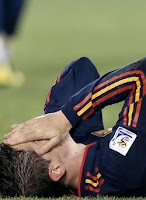
Torres must be starting to wonder if he’ll ever be fully fit again after another important competition passed him by due to injury. He, like many other Premiership players this summer, did not look fit from the beginning and he remained rusty throughout, labouring with and without the ball. After coming on as a substitute in the final, his last minute groin injury meant that, while Spain saw out the remainder of extra time, he was lay prone on the grass, covering his face with his hands. Football and the future must have seemed pretty bleak as he received treatment for yet another injury while his compatriots celebrated victory at the final whistle.


Steven Pienaar (South Africa)

Heralded by every TV commentator as South Africa’s hero, it became impossible for Pienaar to touch the ball without a pundit reminding us of ‘what a season he had at Everton’. Unfortunately, while they waxed lyrical about the tackles he made away at Bolton last season, Pienaar was being outpaced as he made futile attempts at beating his marker. Pienaar looked slow and ineffective in all South Africa’s World Cup matches and was overshadowed by more dynamic team-mates like Siphiwe Tshabalala. He may well have had a decent season with Everton last year but, without Cahill or Arteta alongside him, he looked as average as his club side.


Nicklas Bendtner (Denmark)

After Denmark quietly bowed out at the group stage, the self-proclaimed greatest striker on the planet revealed he was carrying an injury at the World Cup. Arsenal will, in a perverse way, be hoping Bendtner isn’t just making excuses, as he was totally mediocre for the Danish. It would hardly have taken a virtuoso performance to look good playing up front with a decrepit John Dahl Tomasson but Bendtner often looked the least threatening out of the two and contributed little more than several miscued shots and some uninspiring back-passes. His optimistic assessments of his own ability mean he’s subject to added scrutiny, which, particularly on this occasion, is unfortunate.


Vincenzo Iaquinta (Italy)

Italy looked conservative and toothless in attack throughout their group games and it was baffling that Iaquinta played so much despite Lippi having Quagliarella in the squad. Iaquinta was slow, his first touch was consistently terrible, and he forced Italy to play a fruitless long ball style on numerous occasions. The sort of pace, craft and technical ability Quagliarella had to offer became evident during the second half of Italy’s match against Slovakia, when he played in his only game of the tournament. Iaquinta will be too old to play in Brazil 2014 and he was too inept to have played any major role in World Cup 2010.


Humberto Suazo (Chile)

There was always likely to be a certain level of curiosity, if not firm expectation, about a player who has been named The World’s Top Goal Scorer in the past, even if his 52 goals from 54 games in 2006 were scored in the Chilean league. Ultimately, Suazo’s tournament was compromised by a hamstring problem but in two appearances he committed unnecessary fouls and fluffed several good chances. Alexis Sanchez was the real spearhead of a fast, attacking Chilean side and Suazo looked more like hindrance than help whenever he got involved.


France

Even without Zidane, the French team was still good enough on paper to compete at a World Cup. Having players like Evra, Malouda, Anelka, Gallas, Sagna, Abidal, Ribery, Cisse and Henry should have ensured much better performances than France gave in Group A. No-one expected much from the French side but they still underachieved. Domenech should have been sacked years ago, it’s just a shame for the French people that members of their football federation were the only ones who didn’t see it.

Thursday, 10 June 2010

You're not giving me the horn

On the eve of the opening match, the only phenomenon likely to spoil the 19th FIFA World Cup, other than injury to the best players, is the vuvuzela.

The vuvuzela, a plastic trumpet about a metre in length that emits a flat, loud, monotone blare, has been adopted by South African football fans as a symbol of their enthusiasm but was almost banned from this year’s World Cup after complaints from European players and coaches, and most broadcasters.

The decision not to ban these ‘instruments’ will prove detrimental to the world’s enjoyment of the tournament and the reasons behind allowing them are driven by political correctness and a confusion over the real issue with the vuvuzela.

When Sepp Blatter admonished those advocating a ban by saying, ‘we should not try to Europeanise an African World Cup.’, he showed that he had completely missed the point. A ban on the vuvuzela is not a ban on South African football culture, it is merely removing one particular element of it that the majority of people seem to find, at the very least, rather irritating. It is not racist or an attempt to impose an alternative culture on a group of people to ban the use of one particular instrument. Blatter adds that African and South African football ‘is all about excitement, dancing, shouting and enjoyment’, and nobody is trying to stop that; conflating the drone of thousands of vevuzelas with ‘excitement, dancing, shouting and enjoyment’ is absurd.

In any case, there is enough evidence to suggest that the vuvuzela is far from an ancient African artifact and actually a cunning invention by someone with entrepreneurial spirit and a faith in mob culture. There will certainly be a few people somewhere that like the vuvuzela, knowing that they’ve become a whole lot richer courtesy of those who decided it was better to pay for an oversized horn than make noise with their own (free) voices.

There is a need to recognise that there are some noises that we, as human beings, find deeply unpleasant. If, through some strange arrangement, the FA supplied every England fan with a chalkboard and asked them to scratch them incessantly for 90 minutes, people from other countries could, legitimately, demand that they refrain. The same would be true if German fans were all given a copy of their Eurovision entry for 2010 and asked to play it on their own personal ghetto blasters inside the ground for a full 90 minutes.

This last scenario would, in fact, be more musical than the noise the vuvuzela makes. It is bad enough to have been compared to the tortured wail of a dying elephant, so when writers begin articles with sentences like, ‘Music will play a big part [in the world cup], and in particular, a trumpet called the vuvuzela’ they are, in fact, making paradoxical statements. There is nothing to recommend one, flat droning note as ‘music’, just in the same way you wouldn’t liken the noise of a washing machine to a Brahms violin sonata.

For all the accurate descriptions of the awful noise this terrible invention makes, it would not be so unbearable, and there would not be such desire to ban it, if it didn’t go on constantly. It's not the noise they make per se, but that fact that it never stops. Apologists for the vuvuzela talk about the ‘electrifying atmosphere’ it creates, when in fact it does nothing but drown out all other noise and detract from the match. People blowing the vuvuzelas do so all the time, with no reference to actual events in the game. It creates the impression that most of those in the stadium have very little interest in the football itself. If fans blew them in reaction to on-field events rather than relentlessly, the noise wouldn’t be so intolerable and might genuinely add to the atmosphere, as there would be some contrast in its volume over the course of 90 minutes. If someone wants to argue that the idea of fans reacting to on-field events is inherently European, then we should also admit the argument that blowing a trumpet constantly for 90 minutes, with no regard for the football, is inherently moronic. Thousands of vuvuzelas blown constantly do nothing for the atmosphere but create expressionless and soulless noise that detracts from more rousing crowd noise, including the euphoria of goal celebrations and the drama of controversial decisions.

Ultimately, the vuvuzela will prove to be an irritant and possibly the lasting legacy of the 2010 World Cup. It’s a pity for those interested in watching the tournament over the next six weeks but the real losers will be the people of Africa because the rest of the world will want their football played elsewhere from now on.

Monday, 21 September 2009

Boating in Amsterdam

Despite numerous previous visits, I had never seen the tall, wonky buildings and bicycle-clad bridges of Amsterdam from the unique perspective of the canals, and with this playing on my mind, my compatriots and I made our way down to the docks to hire an aqueous steed for the afternoon.

We arrived at a small hut at the end of a rickety jetty. It was roughly twice the size of a portaloo and on approach one could only envisage a troll angrily emerging from inside, scuttling up the jetty to the creaking, swaying bridge between jetty and canal bank, and manically waving his arms around whilst roaring a torrent of indecipherable abuse in an attempt to defend his territory. This, however, was not to be the case, as on inspection the shack was sparsely decorated with sailing accoutrements but eerily bereft of human (or troll) life.

In the enforced lull we took time to inspect the boats for hire. Whilst robust and evidently seaworthy, these were not the plush, comfortable motorboats frequently observed making waves serenely through the city's famous waterways. In fact, the boats were no more than several different sized sheets of steel welded together. The concept of relaxed and comfortable seating was poorly represented by three strips of bare metal which braced the boat width ways. It was at this point in the assessment that a man approached our party.

Bounding carefree over other small boats tied to the dock came a small fellow of oriental descent, evidently the proprietor or a person working under the employ of such a figure. He seemed a genial man, eager to iron out the bureaucratic formalities that would characterise our final few moments on terra firma and with them smoothly out of the way, he instructed us on the methods of steering and propelling our craft. Furnishing us each with a small sheet of five millimeter thick foam to protect our posteriors from numbness, our cruise facilitator untethered us from the dock and, with trepidation, we began to navigate the most major of the canals that we would encounter during our journey, one that would take us to the network of smaller canals in the heart of Amsterdam.

Having traversed the aforementioned intimidating stretch of water, we breathed a collective sigh of relief as the canal banks closed around our boat and we became free to concentrate on the scenery about us. We made past other travelers relaxing on the bank with drinks and snacks, under arched bridges alive with the sound of cyclists' bells and through streets lined with homes that tilted and slanted in numerous directions. As we coasted past moored canalboats serving as dwellings, adorned with furnishings and decoration to make them warm and welcoming places to inhabit, the sun threw off its blanket of cloud and cast warm, gentle rays over the water, ripples sparkling and twinkling in appreciation.

The general novelty of our predicament began to wane after some time and we continued our slow but steady progress through the canals considering what direction best to point our vessel. Soon we were heading for a notorious thoroughfare of Amsterdam, one made famous by a multitude of harlots who repeatedly bequeath the fruits of their loins to gentleman willing and able to pay suitable recompense. It would be a delightful folly, thought the three of us, to witness the usual scenes of exhibition, bravado and barter from the comfort of our boat.

We eventually reached the top of the particular canal. The sunshine became more modest and the sky grayed somewhat, various shades of neon red still visible in the daylight. Flesh jiggled in windows, eyes attempted to ensnare, fake fingernails tapped on windows, folds of unkept skin obscured economical undergarments. Giggling, intrigued tourists walked in parallel with our boat on the canal banks, mixing all the time with groups of boisterous, leering men and shabbily dressed individuals quietly exiting doorways or surreptitiously making enquiries. Our steel tub continued to slice through the water, the occasional swan gently swimming out of our path, its gleaming white plumage in stark contrast to the dull, litter-strewn water beneath, and the seedy machinations of the street in whose midst it now swam.

Two thirds of our journey down this canal, we came across an unusually high volume of ducks. Perhaps, we conjectured, this was related to the amount of food-related litter deposited in the water on this stretch, thanks to its popularity with tourists and sexually repressed males, of which, surely, there are many. Thankfully these ducks were taking evasive action in order to avoid collisions with our vessel, much like the swans, including swimming from its path but also, on this occasion, flying away from the bow of our ship.

A piercing shriek from an associate suddenly drew my attention and almost before I'd turned around to regard my company I felt repeated and heavy thuds on my head, as if a torrential rain shower had begun. In that same instant, I adopted a cowering posture, similar to that of the brace position made famous by flight attendants, and could only wait in this defensive position until the deluge had subsided. When I straightened myself and turned to my shipmates with a look of both shock and dread on my face, the exact nature of our misfortune quickly became apparent. At first I thought we may have been pelted by jealous contemporaries from the shore but it was with alarm I realised that our craft and its party had been heavily defecated on by fleeing ducks. Our clothes were streaked with earth coloured stains, each of which had a nucleus of grit which was quite clearly feces. Numerous witnesses laughed uproariously, as well they might, while we smiled in resigned dismay, contemplating the fact that we were at our furthest point from the harbour, with at least an hour's journey back through Amsterdam's waterways covered in shite.

With heavy hearts we set out on the long, ardous path back to the dock. The overcast skies and falling temperatures seemed to mimic the sombre atmosphere aboard our craft. At every turn the waterways seem to stretch endlessly toward the horizon, a prospect which reminded me of tales of adventure involving Columbus, Vasco Da Gama and Ferdinand Magellan.

Through careful retracing of our steps, we eventually made it back to the first, wide expanse of water where our voyage had begun. As the small rental shack came into vision, our boat began to slow from its usual, deliberate walking pace to a state of total inertia. We were all immediately concerned; I wondered if perhaps a used prophylactic had become entwined on our propellor but after closer inspection the offending article happened to be a plastic bag. With no propulsion or steering, our craft gradually began to turn 180 degrees and bob gently back the way we had come, like flotsam and jetsam being washed out to the ocean. My associates, by now, were frantically attempting to remove the detritus that was preventing us from continuing and were doing so with scant regard to the weight distribution in the boat. The danger of us capsizing was tangible, and as a man who was cold, in need of refreshment, drifting in the direction opposite to the one in which I wished to go, and covered in shite, I did the only thing I could and collapsed in the boat, in tears of delirious hysterics.

When we finally arrived back at our mooring we paid our good friend his frankly exorbitant fee for the use of his boat. Being the conscientious man he so clearly was, he politely asked us if we had enjoyed ourselves and, lest he should notice the shite that was so abundant about our personage and so deep within the hairs on my head, we sheepishly said yes and quickly made off to our residence.

Friday, 29 May 2009

Bulletproof

La Roux have been rattling the loose fixtures in my flat with their Skream remixed version of In For The Kill for the last couple of months.

Please find attached the video for their new single Bulletproof. Watch for it raining shapes in the Tron influenced video at 2:35.

Back with some writing in the next few days.

Friday, 1 May 2009

It was acceptable in the 80s (and now)


Ah, fashion; crazy isn't it? There I was, as a 15 year old, hating anything and everything the 1980s had to offer and now I'm like a rabid dog frothing at the mouth with glee anytime I see a shellsuit or hear a synth or a vocoder. Step in 2000F & J Kamata to prove my point: You Don't Know What Love Is.

Sun, drinks, music and a bank holiday weekend. These days are why we bother.

Sunday, 19 April 2009

Heavenly Communications

If he wants to split-up, he should call me, not the other way round.

Saturday, 28 March 2009

'If you can imagine the business as a pie...'

The Office is the best TV series ever - we all know that. Amongst much good work, it pays homage to one of my favourite lexical categories - business speak. Like most annoying human habits, business speak seems borne of insecurity; in this case, suppressed frustration and feelings of inadequacy. Business speak is confusing and unnecessary. It masquerades as something which actively clarifies an idea, when in fact it does the very opposite. It is the antithesis of brevity, concision and clarity. At its very worst, it's used to artificially elevate the user above others and needlessly belittle those who, quite understandably, find it almost undecipherable. Make no mistake; those using it are the ones to be mocked, not those of us who manage just as well with normal English in the office as we do out of it. But now to the point of this post - classic examples...

  • Synergy - e.g. 'I was tasked to create synergy within the company'. Were you? You're an arse.
  • .............-wise - e.g. 'I was dressed too casually so the boss asked me how I was fixed suit-wise.'
  • Eyeballing - e.g. 'Have you had that eyeballed?' 'Who's doing eyeballing today?' 'Let me eyeball that first.' Christ almighty, what's wrong with checking it?
  • Functionality - e.g. 'My workstation has no functionality.' No, there's a problem with your computer.
  • Workstation - e.g. see above. I'd let them have it if they were referring to the desk they sit at but they're not, they're using it as a substitute for the word 'computer'.
  • Visibility - e.g. 'I've got no visibility on that.' You mean you can't see it, or you can't access it.
  • Close of play - e.g. 'I'll have that over to you by close of play today.' If you're in a grotesquely boring office, where people say that sort of thing out loud, without a hint of irony, you won't be able to adequately express how unsuitable using 'play' as a metaphor for 'work' really is.
  • Blue sky thinking - e.g. 'I need some blue sky thinking on how to express my desire to have some original ideas on a given subject.'
  • Communicate - e.g. 'If I want you to go ahead, I'll communicate that to you.' What you'll do, is 'tell' me.
  • Pre-plan - e.g. 'Can we pre-plan for that?' No, you can't. You can plan for it, or not.
  • Action. (v) - e.g. 'I'm going to action that.' 'I'm actioning that as we speak.' ' Has that been actioned?' There are so many wonderfully descriptive verbs in the English language that using 'action' for all of them is more than a shame.
  • Let's run it up the flag pole and see who salutes - Award for the most outlandish business related phrase I've ever heard. Breathtaking.
  • Strategic incompetence - A phrase used to describe the act of doing something deliberately badly in order to avoid doing it again in the future, e.g. making someone an unsatisfactory cup of tea in order to avoid future tea-making duties. This is the only phrase I've ever heard that I like, mainly because it was created in jest.

Thursday, 26 March 2009

NEWS JUST IN

HOLD THE PHONE: Archbishop of Canterbury says God won't sort climate change out for us. He's really gone out on a limb with this one - egg all over his face if God turns up!

Assuming he won't (like the best Dads he has a history of absenteeism) we've all got to face the fact that we've just lost plan A on this issue; it's back to the bloody drawing board for tackling climate change... God - he's such an enigma! Just when we were all relying on him to sort this one out. If I'd told the Christians that God wasn't going to help with this, or for that matter, anything else, they'd have questioned it. There's just no reasoning with some people, there really isn't.

Monday, 23 March 2009

Solitude with trimmings

I just realised that I haven't had a single conversation today; I'm a fresh, exciting new face in the office and my new colleagues just cannot get enough - Mission Ingratiate is complete.

I think today's unusual circumstance subconsciously influenced my choice of listening this evening. It wasn't a full-fat Morrissey evening interrupted only by unexplainable and uncontrollable outbursts of sobbing, but Jeff got a full airing.

Monday, 16 March 2009

Hubble Ultra Deep Field


When the Hubble telescope captured the matter in the above image, it was in fact looking back approximately 13 billion years. Clicking on the photo will take you to a high resolution version that conveys at least some of the beauty of the 10,000 galaxies in the photograph. I hadn't seen this until very recently and it upsets me to think I might never have come across it. I hope you enjoy it as much as I do every time I look at it.

More details can be found on the Wikipedia page for Hubble Ultra Deep Field.

Wednesday, 11 March 2009

Skip ITV


Inside the Guardian’s Media section on March 2, Steve Hewlett wrote much more knowledgably on ITV’s current woes than I ever could.

In short (because you’re likely to be of the generation that can barely concentrate long enough to read a house number i.e. mine) the recession does not bode well for old ITV as nobody has any money to advertise with them. Restructuring the main terrestrial channels that are not funded by license fee money is now important, as their revenues look set to shrink in coming years.

One thing about commerce pre-recession is that, unluckily for their employees, many businesses were only staying afloat because lenders could afford not to call in their debts. Failing businesses with no tangible identity or discernable strategies to create or increase business chugged along while they still could. How bereft do you feel as a consumer now that Woolworths and Zavvi have disappeared? ‘Not very’ I imagine. In the case of these businesses, you can’t help but feel that the recession didn’t cause their deaths but merely hasten them. While feeling sympathy for the unfortunate people who lost their jobs as a result, it should also be recognised that the recession is having this ‘straightening’ effect on business as it separates the wheat from the chaff. Coasting along on credit while ignoring the failings of your business is no longer an option.

This ‘survival of the fittest’ now seems to be applicable to ITV. Undoubtedly the channel is suffering due to a factor beyond their control, but it also seems about time ITV looked at the actual content they offer and see that it is also part of their problem. I read their schedule with more rampant depression than a dyslexic engineering undergraduate going through a reading list for a module on Chomskyan linguistics received in error. It is a veritable goldmine for the collector of poorly executed copies of BBC programmes. It is heaven for those yearning for embarrassing gaffes that interrupt sporting events at their climax and a primordial soup from whence all stuttering, wooden, sports presenters originated. Their few popular programmes are those that satisfy the lust of the morbidly curious voyeur, someone who thrives on others’ humiliation, is immersed in society’s love of judgment and celebrity, and lacks the imagination to do anything other than sit in front of a TV screen while other people make fools of themselves. When was the last time you watched anything on ITV and was it actually any good?

The BBC do great nature programmes and have commissioned some of the best comedies. Channel 4 import some good US TV and make entertaining documentaries. By comparison, ITV stands for nothing apart from lowest common denominator trash, and it would be neither surprising nor distressing if it ended up in the same mass grave as Woolworths, Zavvi and the rest, which it may do unless those at head office give some serious thought to improving the product they are currently offering the consumer.

Thursday, 5 March 2009

Miraculous Mash-up

Take two average pop songs, put them together and what do you have? In most cases, something that manages to be even more woeful than the original ingredients.

However, here we have something miraculous - a mash-up that works! Take quirky, delicious pop morsel Katy Perry, combine with a re-hash of a 2000 vintage, cheddar-laden dance anthem and you have Hot 'n' Cold vs Toca's Miracle 2008. The opening few lines ("You... change your mind... like a girl... changes clothes.") punctuated by the first few twanging notes of Toca's Miracle bring out my game face, a strangely tortured gurning usually reserved for Timbaland bangers and tunes of a similar ilk. For those of you not impressed by Insomnia-esque build-ups, skip to the 3 minute mark to get straight to the moment in question.

'Guilty pleasures' is becoming a recurring theme...